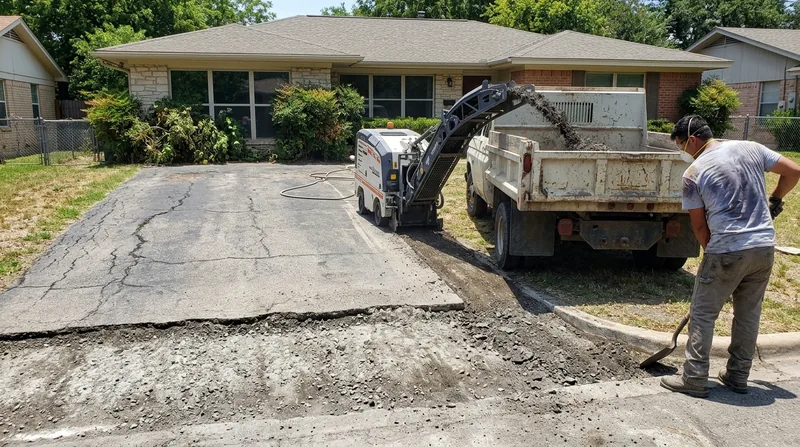




Asphalt Resurfacing & Overlay in Austin restores a worn driveway without the cost and disruption of full replacement. When the surface is cracked, faded, or rutted but the base remains sound, we mill down the old asphalt, apply a tack coat for adhesion, and lay new binder and surface courses pitched to shed Austin's intense afternoon storms. Across central Austin's pre-war bungalow neighborhoods and the post-war ranch subdivisions north and south of I-35, driveways built in the 1960s through 1990s now carry enough surface wear to justify resurfacing. The Blackland Prairie clay that dominates east of the interstate swells and cracks seasonally, and a worn asphalt skin lets water penetrate to that base, accelerating failure. A resurfaced drive extends life by ten to fifteen years at roughly half the cost of replacement, and avoids the weeks of disruption that a full-depth removal requires.
Why Asphalt Resurfacing Matters in Austin's Climate and Terrain
Austin's weather and soil create specific stresses on asphalt. Summer heat cycles the surface, opening micro-cracks that collect water. Spring downpours from the Gulf overwhelm shallow drainage, and that water working into the base accelerates both alligator cracking and edge failure. East of I-35, on the Blackland Prairie clay belt that runs through Pflugerville, Hutto, and Round Rock, the problem compounds: clay swells when wet and shrinks when dry, and a weakened asphalt surface rides that movement year after year, cracking wider with each cycle. A resurfaced drive with proper slope sheds that water before it penetrates, and a tack-bonded overlay binds the old base and new surface into a unified system that resists the movement below.
- A sound base with surface-only wear justifies resurfacing instead of replacement, saving 40 to 50 percent of the cost.
- Milling removes the old surface and creates a mechanical key for the new asphalt to grip, eliminating the slip planes that cause overlay failure.
- Proper crown and slope direct water off the drive and away from the foundation, protecting both the asphalt and the soil underneath.
- New surface courses are placed at the correct thickness and temperature, compacted to density, and cured before traffic loads them.
Resurfacing works because it addresses the surface failure while preserving the structural base, and it works best when the base is still intact and stable.
Key info: In neighborhoods like Hyde Park and Zilker, older driveways were laid on thin caliche base and now show alligator cracking across 20 to 30 percent of the surface. That cracking pattern signals base failure, and an overlay will not hold. A resurfaced drive assumes the base is sound, which we verify on site. If the base is gone, we recommend full-depth replacement instead.
For more on when resurfacing is the right choice and when replacement is necessary, see the Austin Asphalt Paving homepage or call (737) 256-6070 for a free on-site assessment.
How We Resurface and Overlay Asphalt Driveways in Austin
Resurfacing is a straightforward sequence: measure and mill, tack the old surface, place new asphalt in layers, and finish to slope. We start with a site visit to confirm the base is stable and to measure the drive. We then mill the surface to a depth that removes all distress, typically 1.5 to 2 inches. Milling also recovers recyclable material and creates the texture that the new asphalt needs to bond. After milling, we sweep the surface clean, apply a tack coat, and lay the new asphalt in two lifts: a binder course for structural strength and a surface course for wear and water resistance. The entire surface is rolled to proper density while hot, and we slope it to clear water in the direction of the street or drainage.
- We verify the base is sound before we mill, confirming the drive is a candidate for resurfacing and not replacement.
- Milling removes distressed asphalt and recovers material for recycling, reducing waste and cost.
- Tack coat is applied to the clean milled surface, creating a chemical bond between old and new asphalt.
- Binder course is placed first, compacted, and allowed to cool before the surface course is laid.
- Surface course is the wearing layer, placed to proper thickness, rolled to density, and finished with the correct crown and slope.
- We do not seal coat new asphalt for the first six to twelve months while it cures and hardens; sealing too early traps moisture and weakens the bond.
The entire job, from milling through final rolling, typically takes one to three days depending on drive size and access.
Example: A 500-square-foot driveway in Cedar Park with moderate surface cracking and a sound base takes one day to mill and one day to place new asphalt. The drive is ready for light traffic in 24 hours and full traffic after 48 hours. If the same drive had shown alligator cracking across 40 percent of the surface and base failure, we would recommend full-depth milling and replacement instead, which takes longer but solves the structural problem.
Resurfacing and Overlay Methods
| Approach | Description | Best for |
|---|---|---|
| Mill and Overlay | Mill the worn surface 1.5 to 2 inches, tack, and lay new binder and surface courses bonded to the old base. | Driveways with surface wear, minor cracking, and a stable base; extends life 10 to 15 years. |
| Thick Overlay (No Mill) | Place 2 to 3 inches of new asphalt directly over the old surface without milling, using a tack coat for adhesion. | Drives where milling equipment cannot access or where the old surface is still structurally sound and not severely cracked. |
| Full-Depth Replacement | Remove all old asphalt and base material, prepare new base, and place new asphalt in full structural layers. | Drives with alligator cracking, base failure, or structural settlement; provides a new 20-year design life. |
| Selective Patching and Resurfacing | Patch localized failures with full-depth asphalt, then resurface the entire drive for a uniform finish. | Drives with scattered potholes or base failure in isolated areas, combined with overall surface wear. |
Asphalt Resurfacing & Overlay Cost in Austin: What to Expect
Resurfacing costs start at approximately $4 per square foot for a straightforward mill and overlay on a level drive with easy access. A typical 500-square-foot driveway runs $2,000 to $2,500, and a 1,000-square-foot drive ranges from $4,000 to $5,000. The final price depends on several factors: the depth of milling required, the condition and slope of the base, site access for equipment, and the distance the milled material must be hauled. A drive on a steep grade or with narrow side clearance costs more because milling equipment works slower and with greater care. A drive with a poor base or soft spots may require additional base preparation before the overlay, raising the cost. For complex jobs, parking lots, or drives with structural issues, we provide an on-site estimate before any price is quoted.
We recommend getting two or three estimates from local paving contractors. A written estimate should specify the milling depth in inches, the tonnage of new asphalt to be placed, the course breakdown (binder and surface), and the timeline. Estimates that quote only a price per square foot without thickness or tonnage are incomplete and should be clarified before you commit.
For a detailed pricing breakdown and examples specific to your neighborhood, see our full pricing guide or call (737) 256-6070 for a free estimate.
Asphalt Resurfacing & Overlay Near Me: What Austin Homeowners Should Know When Hiring a Paving Contractor
Hiring the right paving contractor is the most important decision in a resurfacing project. A contractor who is fully insured protects you from liability if equipment damages your property or a worker is injured on site. You should verify that the contractor carries general liability and workers compensation insurance and can provide a certificate of insurance before work begins. Ask for references from recent jobs in your neighborhood, and follow up with at least two homeowners to confirm the work was completed on time and to specification. Get written estimates from at least two contractors, and compare the milling depth, asphalt tonnage, and course breakdown, not just the total price. If an estimate is missing tonnage or thickness, ask for clarification before you decide.
Permitting varies by city. Austin requires a right-of-way contractor license and a $10,000 bond for driveway and sidewalk work that touches the curb or apron, and you should verify the contractor's status with the city before hiring. HOA communities may have architectural standards that govern driveway material and extension, and you should confirm those requirements with your HOA before you hire a contractor. We help you navigate local permitting and can advise on whether your specific project requires a permit in your jurisdiction.
- Verify that any contractor you hire is fully insured and can provide proof of coverage before work begins.
- Ask for references from recent jobs in Austin, Round Rock, Cedar Park, or your specific neighborhood.
- Get written estimates with milling depth in inches and new asphalt tonnage specified, not just a price per square foot.
- Confirm permitting requirements with your city or village, and verify the contractor understands local right-of-way rules if your drive touches the street.
- Check with your HOA if you live in a master-planned community, as architectural standards may govern driveway material and width.
A contractor who is local, carries insurance, provides references, and gives you a detailed written estimate is one you can trust. For a free estimate and to discuss your specific drive, contact us or call (737) 256-6070.
Asphalt Resurfacing & Overlay in Austin: Pricing Guide
| Service | Price | Details |
|---|---|---|
| Mill and Overlay Resurfacing | Starting at $4/sq ft | Includes milling 1.5 to 2 inches, tack coat, binder and surface courses, rolled to density and slope for drainage |
| Thick Overlay (No Mill) | Starting at $3/sq ft | Place 2 to 3 inches of new asphalt over existing surface with tack coat; lower cost when milling is not required or possible |
| Base Preparation and Repair | Quoted on site | Soft spots, poor drainage, or settling require additional base work before overlay; cost depends on extent of repair needed |
| Full-Depth Replacement | Starting at $8/sq ft | Complete removal, new base, and new asphalt structural layers; needed when base is failed or alligator cracking covers over 30 percent |
| Travel and Site Visit | Included | No separate mileage or travel fee within Austin and surrounding areas; free on-site estimate with no obligation to book |
Indicative pricing, the exact cost depends on square footage, finish, and site access. Free personalized estimate within 24h at (737) 256-6070.


