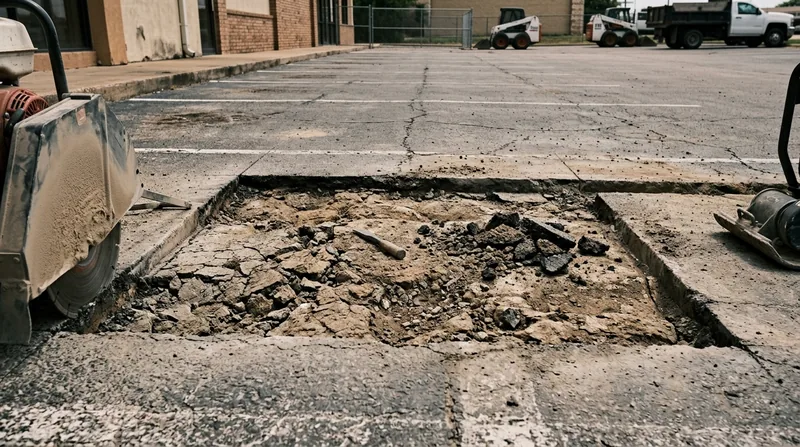




Parking Lot Repair & Resurfacing in Austin means cutting out failed asphalt, rebuilding the base, and patching it flush so the lot holds through the next wet-dry cycle. Austin's Blackland Prairie clay swells when soaked and cracks when dry, lifting parking lots from underneath and breaking the surface into sections that collect water and fail faster. The I-35 corridor through Round Rock, Cedar Park, Pflugerville, and Kyle has older subdivisions with parking lots that have seen twenty years of that cycle. West toward Dripping Springs and the Hill Country, thin soil over limestone and high-intensity storm runoff create drainage problems that undermine bases and blow out patches. We cut out the bad section, rebuild the compacted base to spec, and lay hot mix asphalt flush with the existing surface so the repair holds and blends invisibly into the lot. Get a free estimate from a crew that has been doing this work locally since 2012.
Why Parking Lot Repair Matters in Austin: Clay and Drainage
A parking lot in the Austin growth corridor fails from the base up. The Blackland Prairie clay that runs through the I-35 belt lifts when it absorbs water and shrinks when it dries, creating movement that cracks asphalt and breaks patches loose. A lot that sits on a thin or poorly compacted base accelerates that failure because water penetrates to the clay and the whole slab moves. Storm runoff in the Hill Country west of the city cuts channels under edges and creates washout failures along tree lines and property boundaries. The failure pattern you see first is alligator cracking, wide areas where the surface breaks into small squares, or edge cracking where the perimeter of the lot separates from the adjacent surface. When that happens, water gets under the asphalt, the base loses bearing, and patches fail in weeks instead of years.
- We identify the extent of base failure by sounding the lot and measuring the depth of failed material.
- We remove the failed section entirely, not just patch over it, so the new base is solid.
- We rebuild the base with compacted stone to the depth and density the lot needs to handle traffic and drainage.
- We lay hot mix asphalt at the proper thickness, compacted and finished flush with the existing surface.
- We leave the lot ready to carry traffic immediately after it cools, with no cure time required.
This approach means the repair holds through the next storm season instead of failing again in a few months.
Key info: A parking lot in Cedar Park or Round Rock that shows alligator cracking across more than thirty to forty percent of the surface is past patching. The base is compromised, and the lot needs the failed section cut out and rebuilt, not sealed or patched. Trying to patch a lot with that much failure throws money away.
For more on how we approach asphalt repair across the Austin area, see our asphalt repair page. And if you have questions about whether your lot needs repair or full resurfacing, call (737) 256-6070 for a free estimate and we will walk you through it.
How We Repair and Resurface Parking Lots in Austin
The work starts with a site visit to measure the lot, identify failed sections, assess the base, and check drainage. We look at how water moves across the surface and where it sits, because standing water is a sign that the lot has settled or the base is compromised. We take core samples if needed to see how deep the failure goes and what the base looks like. Then we write an estimate that shows the square footage of repair, the depth of base we are rebuilding, the tonnage of asphalt we will lay, and the price. We do not give a price per square foot because every lot is different, and a lot with a bad base costs more to repair than a lot with a solid base under thin surface cracking.
- We mark out the failed section with clear lines so the cut is straight and the edges are clean.
- We saw-cut the perimeter, then remove the asphalt and the failed base material down to solid ground.
- We compact the subgrade, then lay and compact new stone base in lifts to the proper depth and density.
- We proof-roll the base with a heavy vehicle to confirm it is solid and will not settle under traffic.
- We lay hot mix asphalt in one or more lifts, depending on the depth needed, and compact it to density.
- We finish the surface flush with the existing lot so water drains properly and there are no trip hazards at the edge.
A parking lot repair in Pflugerville or Kyle that removes thirty to fifty square feet of failed surface and rebuilds the base takes one to two days. Larger lots or lots with multiple failed sections take longer, and we schedule the work so traffic disruption is minimized.
Example: A small commercial lot in Austin with a twenty-by-thirty-foot section of alligator cracking and base failure. We cut it out, rebuild the base four inches deep with compacted stone, and lay two inches of hot mix asphalt. The repair is invisible once it cools, the lot drains properly, and the repair holds through the next five to seven years of use. Total time on site is one day. Cost is in the $2,500 to $3,500 range depending on access and haul distance.
For lots that are failing over a larger area, asphalt resurfacing or an overlay may be a better choice than multiple patches. We help you decide what makes sense for your lot and your budget.
Parking Lot Repair Methods
| Approach | Description | Best for |
|---|---|---|
| Full-depth patching | Remove failed asphalt and base, rebuild base with compacted stone, lay hot mix asphalt flush with the lot. | Localized failures, base damage, alligator cracking in one or two sections of the lot. |
| Asphalt overlay | Mill the top layer of the existing lot to remove surface damage, then lay a new layer of hot mix asphalt over the existing base. | Lots with solid bases but surface wear, alligator cracking across less than thirty percent of the surface, or minor drainage issues. |
| Mill and overlay | Mill the entire existing asphalt surface, remove it, and lay a new wearing course over the existing base. | Lots where the base is still good but the surface is worn, cracked, or rutted across most of the area. |
| Full-depth reclamation | Mill the asphalt and the top layer of base together, remix them with new asphalt cement, and re-lay the recycled mix as a new base and surface. | Large lots with extensive failure, lots where haul distance makes waste expensive, or where recycled asphalt content is a priority. |
The right method depends on how much of the lot has failed, how deep the failure goes, and what the base looks like. We assess that on site and recommend the approach that gives you the best value and the longest life.
Parking Lot Repair & Resurfacing Cost in Austin: What to Expect
A parking lot repair in Austin starts at around $650 for a small localized patch, but most commercial lots have larger failed areas that cost between $2,500 and $5,000 to repair. A full lot resurfacing or overlay runs $8,000 to $25,000 depending on the size of the lot, the condition of the base, and whether you are milling or just laying new asphalt over the existing surface. The biggest cost drivers are the square footage of the lot, the depth of base failure, whether the base needs to be rebuilt or just topped, and the distance we have to haul material on or off site.
A lot in Cedar Park with a two-hundred-by-one-hundred-foot surface and a few isolated failed sections will cost less to repair than a lot in Kyle with widespread base failure across the entire area. A lot with good drainage and a solid base under minor surface cracking is a candidate for an overlay, which is cheaper than full-depth repair. A lot where the base is compromised across most of the surface needs more extensive work and costs more.
The only way to know the real cost for your lot is to have us come out and measure it, look at the base, and give you a written estimate with the square footage, the tonnage of material, and the labor. We do that for free and will walk you through why the price is what it is. You can then get estimates from other contractors and compare. See our pricing overview for more detail on how we structure estimates, and call (737) 256-6070 to schedule a free site visit.
Pricing note: We quote all parking lot work on site by measurement and material, not by a per-square-foot rate. That is because a lot with a solid base costs far less to repair than a lot where the base has failed. Getting two or three estimates is smart, because you will see variation based on how each contractor assesses the base and what depth of repair they recommend.
Parking Lot Repair & Resurfacing Near Me: What to Look for When Hiring a Contractor
A good parking lot contractor in Austin or Round Rock is local, carries full insurance, has references you can call, understands the local clay and drainage issues that cause lots to fail, and gives you a clear written estimate before the work starts. The contractor should be willing to explain why they are recommending a particular repair method, and should not push you toward a full replacement if a repair or overlay will actually solve the problem. They should also understand local permitting, because some municipalities require you to notify the city before you resurface a lot, and some HOAs or commercial properties have architectural standards that govern the work.
- Ask for references from lots they have repaired in your area, and call at least two to ask how the work held up and how the contractor handled the job.
- Get a written estimate that shows the square footage of work, the depth of base, the tonnage of asphalt, and a clear price with no hidden fees.
- Verify that the contractor carries liability insurance and can provide a certificate of insurance before the work starts.
- Ask whether the lot is in a right-of-way or touches a city street, because that may require a permit from the city, and the contractor should help you navigate that.
- If the lot is in an HOA community, check the architectural standards to make sure asphalt repair is permitted and whether there are color or finish requirements.
- Confirm that the contractor will call 811 before any excavation, because buried utilities are a real risk and the law requires locates before you dig.
Avoid contractors who show up unsolicited, offer a price on the phone without seeing the lot, ask for a large cash deposit before the work starts, or have out-of-state plates. Those are common warning signs in the paving business. Instead, work with a contractor you can verify locally, who takes time to understand your lot, and who puts the estimate in writing. Contact us for a free estimate and we will show you exactly what we recommend and why.
Parking Lot Repair & Resurfacing in Austin: Pricing Guide
| Service | Price | Details |
|---|---|---|
| Small localized patch | Starting at $650 | Includes removal of failed asphalt and base, base rebuild, and hot mix patch, up to fifty square feet. |
| Medium repair, full-depth patching | Starting at $2,500 | Fifty to one hundred fifty square feet of failed surface, base rebuild, and asphalt replacement with proper thickness. |
| Large repair or partial lot resurfacing | Starting at $5,000 | One hundred fifty to five hundred square feet, base assessment and rebuild as needed, multiple sections or extensive surface failure. |
| Full lot overlay or mill and overlay | On estimate | Entire lot surface, requires site measurement and base inspection to determine depth of milling and new asphalt thickness. |
| Travel | Included | No charge for estimates or service calls within Austin and surrounding areas; mileage is built into our pricing. |
| Free estimate | No obligation | Written estimate with tonnage and square footage, response within 24 hours at (737) 256-6070. |
Indicative pricing, the exact cost depends on square footage, finish, and site access. Free personalized estimate within 24h at (737) 256-6070.


