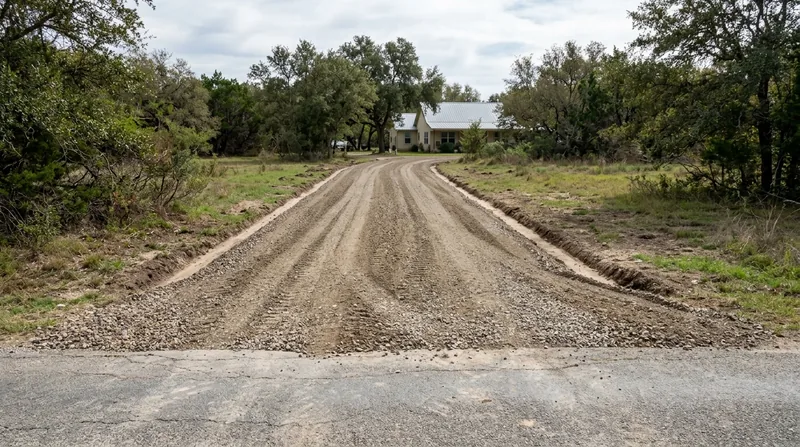




Gravel driveway installation and grading in Austin and the Hill Country solves a real problem: rural lanes and county-road frontage don't shed water the way paved drives do, and without proper crown and base preparation, they channel runoff downhill, erode fast, and wash out in the heavy storms that roll through Bastrop, Burnet, and the limestone country west of the city. We grade the base, establish a crown that moves water off the drive, and lay properly sized gravel that holds under traffic and weather. A well-graded gravel drive lasts years longer than one dumped flat on bare earth, and the difference is visible after the first rain. This is base-prep work that signals expertise, and it's the foundation for any rural property that needs a long-term surface without asphalt.
Why Gravel Driveway Grading Matters in Rural Austin and the Hill Country
The terrain around Austin splits two ways. East toward Bastrop and the Blackland Prairie, clay soil swells when wet and cracks when dry, and a flat gravel drive channels that water downhill like a gutter instead of shedding it. West into Dripping Springs and the hills above the Colorado River, limestone underlies thin topsoil, and runoff cuts fast after the high-intensity storms common to that zone. A county-road lane in either place needs a crowned base and proper grading to survive the first wet season. Gravel is the right material for rural frontage where asphalt isn't justified or where the property owner wants a lower-cost, maintainable surface. The work starts with grading.
- We establish proper slope and crown so water runs off the drive instead of pooling or running downhill.
- We compact the base to create a stable platform that resists rutting under vehicle weight and weather.
- We lay gravel in the right size and depth for a county lane, not a residential parking lot.
- We address drainage and runoff so the drive sheds water after rain rather than holding it.
A properly graded gravel drive moves water off the surface, resists erosion, and gives you years of usable life before re-grading is needed.
Local example: A half-mile county lane off FM 1431 in Bastrop County that was flat and washing out after every storm was re-graded with a 2 percent crown, compacted clay base, and 3 inches of 304 limestone gravel. Two years later, the drive is still solid. The crown keeps spring runoff moving off the surface, and the base holds under the heavy trucks that use the road.
For more on base preparation and the materials that work best for rural properties, see our page on recycled asphalt and millings driveways, which covers alternative surfaces and their durability in this climate.
How We Grade and Prepare a Gravel Driveway in Austin
Gravel driveway grading is a sequenced job. We start by understanding the site: slope, drainage patterns, soil type, and the distance from the road. We then remove any existing surface or debris, establish the crown (a gentle peak running the length of the drive so water sheds to both sides), compact the subgrade, add a base layer, and finish with gravel. The whole process is about creating a surface that moves water and resists the freeze-thaw cycles and heavy rain Austin and the surrounding counties see in spring.
- We measure the drive, stake the crown line, and mark the proper grade elevation.
- We cut and fill to establish the crown, sloping roughly 2 percent from center to edge.
- We proof-roll the base with a compactor to check for soft spots and ensure the subgrade is solid.
- We add a base layer (typically recycled asphalt millings or crusher run) and compact it.
- We finish with properly sized gravel, raked level and compacted lightly so it locks together.
The result is a drive that sheds water, resists rutting, and holds up under regular traffic and seasonal weather.
Real example: A residential gravel drive in Dripping Springs that runs 150 feet from the road upslope to the house was re-graded and crowned with limestone base and 304 gravel. The crown pulls runoff off the center, the base prevents rutting, and the gravel locks in place. The homeowner re-grades once every 18 to 24 months, a minor maintenance cost that keeps the drive solid year-round.
If you are considering moving from a failing asphalt surface to gravel, or upgrading an existing gravel lane, read our guide to private road and HOA paving, which covers the broader context of rural and subdivision surfaces in the Austin area.
Gravel Driveway Installation and Grading Methods
| Approach | Description | Best For |
|---|---|---|
| Crown and compact with gravel finish | We establish a 2 percent crown, compact a clay or recycled asphalt base, and finish with 3 to 4 inches of sized limestone or granite gravel. | New gravel drives or existing lanes that need full re-grading and base prep. |
| Recycled asphalt millings base with gravel top | We compact a 4 to 6 inch layer of recycled asphalt millings as the base, then finish with 3 inches of clean gravel. The millings lock together and provide a stable, semi-bound surface. | Rural drives in Bastrop or Burnet County where durability matters and gravel alone would rut quickly. |
| Crusher run base with limestone gravel | We install 4 to 6 inches of crusher run (crushed limestone and dust that compacts to a hard base), then top with 3 to 4 inches of 304 limestone gravel. This method is the standard for county-road lanes. | High-traffic or long rural drives where the base must resist rut formation and heavy seasonal runoff. |
| Maintenance re-grading and top-dressing | For existing gravel drives that have lost crown or developed ruts, we re-grade, re-compact, and add fresh gravel. No base removal needed unless the subgrade is compromised. | Existing gravel drives in Dripping Springs, Cedar Park, or rural Austin that need seasonal maintenance. |
Each method is sized to the property's traffic, climate exposure, and long-term maintenance plan. We help you choose the right approach during the free estimate.
Gravel Driveway Installation and Grading Cost in Austin: What to Expect
Gravel driveway installation and grading in Austin and the surrounding counties typically starts at $950 for a short residential drive, but the real cost depends on the length of the drive, the condition of the existing base, soil type, and the type of gravel and base material you choose. A 150-foot county lane with a new crowned base and compacted limestone gravel runs higher than a 50-foot residential connector. If the subgrade is clay or there are soft spots, we proof-roll and stabilize, which adds labor. If you want recycled asphalt millings under the gravel (a smart choice for high-traffic or steep rural lanes), that material is priced separately and affects the total.
- Length of the drive is the primary cost driver: longer lanes require more material and labor.
- Base condition matters: if the existing base is solid, we re-grade and top. If the subgrade is soft, we remove, replace, and compact.
- Material choice affects cost: crusher run and recycled asphalt millings cost more than plain gravel, but they last longer and reduce maintenance.
- Site access and slope determine equipment needs and labor hours.
- Drainage work (culverts, swales, or runoff management) is priced separately and depends on site conditions.
The best way to know your cost is a free on-site estimate. We measure the drive, assess the soil and drainage, and quote material and labor. Visit our pricing page for typical ranges, and call us at (737) 256-6070 for a no-obligation estimate.
What to Look for When Hiring a Gravel Driveway Contractor Near Me in Austin
Gravel and base-prep work is straightforward, but it requires someone who understands local soil, drainage, and the seasonal weather patterns that affect rural driveways in Bastrop, the Hill Country, and the Austin suburbs. You want a local contractor who has done this work in your area and can explain why a crowned base matters and what gravel size is right for your traffic and climate. Verify that any contractor you hire is fully insured, ask for references from recent gravel jobs, and get at least two estimates so you can compare approach and price.
- Ask whether the contractor is fully insured and carries liability coverage for the work.
- Request references from recent gravel driveway or base-prep jobs in your area.
- Get a written estimate that includes material type, depth, and labor, so you know exactly what you are paying for.
- Verify that the contractor understands local drainage and soil conditions in your part of Austin or the surrounding counties.
- Ask about maintenance: how often will the drive need re-grading or top-dressing, and what is the expected lifespan.
- Check that the contractor is local and has a verifiable address and phone number in Austin or the surrounding area.
A local contractor who has done gravel work in your neighborhood and can speak to the soil and weather patterns there is worth the call. If you are ready to move forward, contact us for a free estimate, or call (737) 256-6070.
Gravel Driveway Installation & Grading in Austin: Pricing Guide
| Service | Price | Details |
|---|---|---|
| Short residential gravel drive (50-75 feet) | Starting at $950 | Crown and base prep with limestone gravel finish, includes site assessment and compaction |
| Moderate rural lane (100-200 feet) | Starting at $1,800 | Full grading with crusher run base, 3-4 inches limestone gravel, and proof-rolling for stability |
| Long county road or steep terrain drive | Starting at $2,800 | Extensive grading, drainage management, recycled asphalt millings base, and premium gravel with maintenance plan |
| Maintenance re-grading and top-dressing | Starting at $650 | Existing gravel drive re-crowned, compacted, and topped with fresh gravel, no base removal |
| Travel and site visit | Included | No separate charge for estimates or travel within Austin and surrounding counties |
| Free estimate | No charge | Call (737) 256-6070 for on-site assessment and written quote within 24 hours, no obligation |
Indicative pricing, the exact cost depends on square footage, finish, and site access. Free personalized estimate within 24h at (737) 256-6070.


