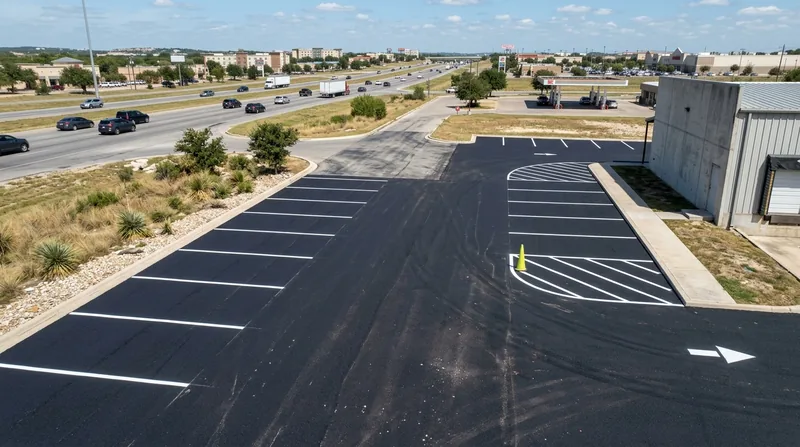




Commercial parking lots across the I-35 corridor in Austin, Round Rock, Cedar Park, and Pflugerville face a unique set of demands. East of the interstate, Blackland Prairie clay swells when soaked and cracks when dry, putting stress on any surface that sits above a weak base. West into the Hill Country, thin soil over limestone means drainage is fast and steep, and runoff cuts channels into an undersized pad. Triple-digit summers and sudden high-intensity storms mean the asphalt itself must be rated for thermal stress and water infiltration. Parking Lot Paving & Construction in Austin requires a base engineered for the ground beneath it, grading that sheds water, and hot mix that holds up to the climate. We grade for drainage, compact a base sized for the trucks your business runs, and lay asphalt built for Austin's weather extremes.
Why Parking Lot Paving & Construction Matters in Austin's Commercial Landscape
A parking lot is not a driveway. It carries heavier traffic, more concentrated loads, and often sits on ground that was graded and filled without the compaction standards modern asphalt requires. In the subdivisions built through the 1990s and 2000s along the I-35 belt, lots that were poured on clay without a proper base are now showing their age. Cracking spreads fast once water gets under the surface. Potholes follow. In the Hill Country west of Austin, a lot graded into a rock cut without attention to runoff channels water across the surface, eroding the edges and the seams. The cost of ignoring these problems is not just repair later, it is liability, drainage failure, and a surface that looks neglected to customers and tenants.
- We grade the lot for proper drainage so water sheds toward storm drains or swales, not toward the building.
- We compact a base layer sized for the vehicle loads your business actually carries, not a one-size-fits-all minimum.
- We lay hot mix asphalt rated for Austin's thermal cycling and the high-intensity storms that dominate spring and fall.
- We measure tonnage and thickness on every job, so you know exactly what you are getting and what it will hold.
A well-built lot holds for 15 to 20 years with routine maintenance. A lot built on an undersized base fails in half that time, and the cost to fix it is far higher than the cost to build it right the first time.
Key info: Austin's City Code requires stormwater management for new or expanded impervious surfaces. Your lot must drain to an approved system, and the City verifies this before final sign-off. We help you navigate these requirements and grade the lot to meet them.
For more on how proper base preparation prevents costly failures, see our work on Parking Lot Repair & Resurfacing.
Additional information on Austin's stormwater and drainage rules is available at Austin Development Services.
How We Build a Commercial Parking Lot in Austin: Step by Step
Parking lot construction is not a pour-and-go operation. The ground preparation is where the job is won or lost. On clay soil, we grade out the lot, identify low spots and drainage paths, and then compact a base layer to the density that will support the asphalt and the loads above it. On Hill Country terrain with rock and thin soil, we grade to the rock, verify drainage patterns, and build the base to shed water quickly. Every lot is measured, tonnage is calculated, and the compaction is verified before we lay the asphalt. This is the work that keeps a lot from cracking and potholing in five years.
- We meet on site, walk the lot, and identify drainage patterns, soft spots, and the soil type beneath the surface.
- We grade the lot to establish proper slope and direct water toward storm drains, swales, or the street.
- We compact the base layer in lifts, testing density and moisture to ensure it will support asphalt and traffic loads.
- We lay hot mix asphalt in lifts, compacting each pass to achieve the density and thickness specified for your lot.
- We measure tonnage, thickness, and compaction on the finished surface so you have documentation of what was installed.
A typical commercial lot in Round Rock or Pflugerville takes three to five days from start to finish, depending on size and site access. You can drive on the asphalt the next day, but the surface will continue to cure for six to twelve months. Do not seal the lot during that window; sealing too early traps moisture and can cause adhesion failure.
Example: A 15,000-square-foot lot in Cedar Park on clay soil with poor drainage required a 6-inch compacted base and 3 inches of hot mix asphalt. We graded for slope, compacted the base in two lifts, and verified density with a nuclear gauge. The finished lot sheds water, carries the owner's fleet, and is built to last 15 to 20 years if maintained.
For details on how we handle resurfacing an existing lot instead of full reconstruction, visit Asphalt Resurfacing & Overlay.
| Approach | Description | Best For |
|---|---|---|
| Full-Depth Construction | Grade the subgrade, compact a 4-8 inch base, lay 2-3 inches of hot mix asphalt. Best for new lots or complete removal of failed pavement. | New construction, failed lots, or when existing base is compromised. |
| Mill and Overlay | Remove 1-2 inches of old asphalt, recycle it, compact the remaining base, and lay new hot mix on top. Faster and less expensive than full depth. | Lots with sound base and surface wear, cracking, or minor settling. |
| Pothole and Spot Repair | Remove failed asphalt and base, compact new base, and patch with hot mix. Works for isolated failures, not widespread cracking. | Potholes, localized soft spots, or edge damage on otherwise sound lots. |
| Seal Coat and Stripe | Clean and stripe an existing lot without removing asphalt. Does not address cracking or structural issues, only appearance and water shedding. | Maintenance on sound lots, appearance refresh, or temporary extension of life. |
Parking Lot Paving & Construction Cost in Austin: What to Expect
Parking lot cost depends on four main factors: lot size, soil type, drainage requirements, and the depth of base and asphalt your lot needs. A lot on stable clay with good drainage in Austin may need a 4-inch base and 2.5 inches of asphalt. A lot on Hill Country terrain with poor drainage or heavy truck traffic may need a 6-inch base and 3 inches of asphalt. The difference in tonnage and labor is significant. A 10,000-square-foot lot on a standard base runs into the mid-range for commercial work. A 25,000-square-foot lot with extensive grading and drainage work moves into a higher bracket. The only way to know where your lot falls is a free commercial estimate on site, where we measure, identify the soil, and calculate tonnage.
We provide written estimates with tonnage and thickness specs, so you know exactly what the cost covers and why. Do not accept a quote that does not include these details. A per-square-foot price without tonnage is a red flag; asphalt is priced by the ton, and the tons required depend on the base depth and compaction, not just the surface area.
For a detailed pricing overview and to request your free estimate, visit our pricing page.
Parking Lot Paving & Construction Near Me: What to Look for When Hiring a Contractor in Austin
Hiring the right contractor for a commercial parking lot is not a race to the lowest bid. A lot is a long-term asset, and the cost of cutting corners on base preparation or asphalt thickness is paid in premature failure and liability. Before you call, know what to ask for and why it matters. Ask for references from commercial lots built in the last five years. Ask for tonnage and thickness on the estimate, and ask how the base will be compacted and verified. Ask whether the contractor is fully insured and carries general liability coverage for the work. Ask about the timeline and how the lot will drain during construction. If a contractor cannot answer these questions clearly, move on.
- Verify that the contractor is fully insured for commercial work and carries the coverage limits your business or property requires.
- Request an on-site estimate that includes lot measurements, tonnage calculations, base depth, asphalt thickness, and a timeline.
- Ask for references from other commercial lots in the Austin area built within the last five years.
- Confirm that the contractor understands Austin's stormwater and drainage rules and will grade the lot to meet City requirements.
- Get a written contract that specifies tonnage, thickness, compaction method, and the warranty on workmanship.
A contractor who has been in the Austin market for years and understands the local soil, drainage, and climate is worth more than a traveling crew offering a one-time deal. Call us at (737) 256-6070 for a free commercial estimate, and we will walk the lot with you, answer your questions, and give you a detailed quote with no obligation to book.
Parking Lot Paving & Construction in Austin: Pricing Guide
| Service | Price | Details |
|---|---|---|
| Free commercial estimate | Free | On-site lot walk, soil assessment, drainage review, tonnage calculation, and written proposal with no obligation |
| Full-depth lot construction | Starting at $3.50/sq ft | Grading, 4-6 inch compacted base, 2.5-3 inch hot mix asphalt, includes site prep and tonnage verification |
| Mill and overlay | Starting at $2.00/sq ft | Mill 1-2 inches, recycle material, compact remaining base, lay new hot mix asphalt for surface restoration |
| Pothole and spot repair | Starting at $150 | Per pothole: remove failed asphalt and base, compact new base, patch with hot mix, typical repair takes 1-2 hours |
| Travel and site visit | Included | No mileage fee or call-out charge for estimates or jobs anywhere in Austin and surrounding areas |
| Estimate response | Free | Call (737) 256-6070 for a free estimate, response within 24 hours, no obligation to book work |
Indicative pricing, the exact cost depends on square footage, finish, and site access. Free personalized estimate within 24h at (737) 256-6070.


