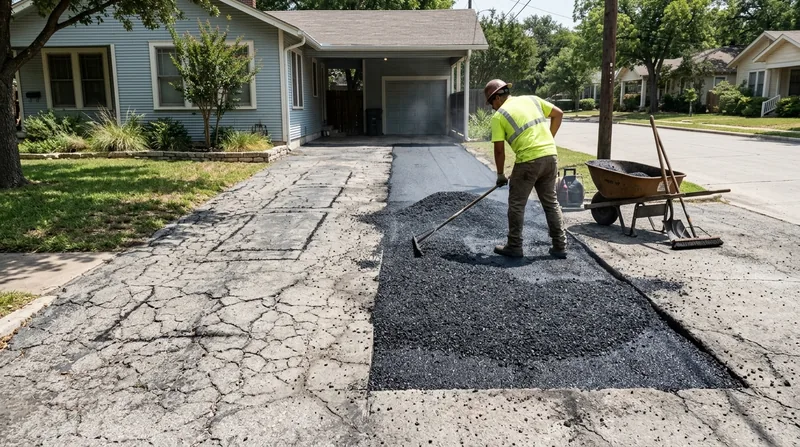




Austin driveways crack and lift where Blackland Prairie clay swells after a storm, then dries out weeks later and pulls the asphalt apart. The pre-war bungalows of Hyde Park and Travis Heights sit on deep lots with short drives laid over caliche without proper base, while the post-war ranch ring in Northwest Hills and Allandale added wider single and double-car drives on slightly larger footprints. North and south along the I-35 corridor through Round Rock, Pflugerville, Cedar Park, Buda and Kyle, subdivision belts built in the 1990s and 2000s now carry driveways old enough for their first real repair or resurfacing. Driveway Repair in Austin means opening the cracked sections, rebuilding the base where clay has washed out, and patching with hot mix asphalt so the surface holds through the next dry spell and the next storm cycle.
Why Driveway Repair Matters in Austin: Clay Swell and the Cycle of Cracking
Blackland Prairie clay is the dominant soil across central Austin and the I-35 corridor suburbs. When a heavy rain soaks the clay, it swells. When the sun returns and the soil dries out over the next two to four weeks, it shrinks and pulls away from the asphalt above it. That repeated cycle cracks the pavement and breaks the bond between the surface and the base. Without repair, those cracks widen, water seeps underneath, and the base material (often just compacted caliche on older driveways) washes away. The cracked section then fails entirely, and what started as a repair job becomes a resurfacing or replacement.
- We open the cracked asphalt, remove failed base material, and rebuild the subgrade with proper compaction.
- We set new hot mix asphalt into the opening and trowel it level with the surrounding pavement.
- We proof-roll the patch to ensure it bonds and compacts fully before traffic returns.
- A timely repair stops water infiltration and prevents the cost of a full resurfacing or replacement later.
Getting repairs done in spring, after winter freeze-thaw has opened new cracks but before summer heat hardens the clay, is the most effective window.
Key info: In East Austin and areas built on Blackland Prairie clay (Pflugerville, Hutto, parts of Round Rock), driveways crack in patterns that follow the soil swell cycle. Older drives in these areas often lack adequate base, making repair and resurfacing more common than in Hill Country properties where limestone bedrock and thinner soil over rock create different failure modes.
For more information on how soil conditions affect your driveway, see our page on Gravel Driveway Installation and Grading, which covers base preparation and drainage.
How We Repair Driveways in Austin: From Diagnosis to Lasting Patch
Driveway repair is not a one-size operation. A single crack with a sound base underneath is a simple fill-and-trowel job. Alligator cracking (a web of small cracks) signals that the base has failed, and patching alone will not hold. We inspect the crack pattern, probe the base, and tell you whether a patch will last or whether the money belongs in resurfacing or replacement. If repair is the right call, here is how we work.
- We measure the cracked area and mark the cut lines with chalk.
- We cut straight edges around the failed section using a circular saw with an asphalt blade.
- We remove the cracked asphalt and any soft or washed-out base material underneath.
- We inspect the subgrade, repair or compact the base layer, and proof-roll it to ensure stability.
- We set hot mix asphalt into the opening, working it in layers if the patch is deep.
- We trowel the surface level with the surrounding pavement and allow it to cool before opening to traffic.
The entire process typically takes one day for a patch up to 200 square feet. Larger or multiple patches may require a second visit.
Local example: A homeowner in Cedar Park noticed a two-foot-long crack running across the middle of a narrow driveway. Inspection showed the crack had opened because clay underneath had swollen and pulled the asphalt apart, but the base itself was still firm. We cut the crack out cleanly, compacted the base, and set a new patch with hot mix. The repair cost less than a third of a full resurfacing and has held through three seasons of Texas heat and rain.
If you have multiple cracks or alligator cracking across a large section of your drive, asphalt resurfacing may be the more durable choice.
Driveway Repair Methods: Patch, Pothole, and Base Rebuild
| Approach | Description | Best for |
|---|---|---|
| Crack Repair | Cut out the cracked section in a clean rectangle, inspect the base, compact if needed, and set hot mix asphalt flush with the surrounding pavement. | Single or isolated cracks with a sound base underneath. |
| Pothole Patch | Remove the failed asphalt and base material from a pothole, clean out water and debris, rebuild the base layer, and set new hot mix in stages if the hole is deep. | Potholes and areas where the base has washed away completely. |
| Full-Depth Patch | Cut out both the asphalt and the failed base layer, rebuild the subgrade and base with proper compaction, and set new asphalt to full depth. | Large areas with extensive base failure or alligator cracking. |
| Resurfacing (Overlay) | Mill off the top layer of old asphalt or lay a new layer directly over the existing surface, after addressing drainage and base issues. | Multiple patches, widespread cracking, or a drive that is structurally sound but worn. |
Choosing the right method depends on the size of the failure, the condition of the base, and how much of the driveway is already compromised. A patch holds when the base is sound. Once alligator cracking covers roughly 30 to 40 percent of the surface, the base is failing across a wider area, and patching throws money away. We assess the crack pattern and the base condition on site and recommend the approach that will hold longest and cost least over time.
Driveway Repair Cost in Austin: What to Expect
Driveway repair costs in Austin start at around $450 to $600 for a single crack or small pothole, and scale upward based on the size of the failed area, the condition of the base, and how deep the patch needs to be. A typical repair covering 100 to 200 square feet usually runs $800 to $1,500. If the base is soft or washed out and requires significant rebuild, the cost can move higher. Multiple patches across the same driveway often cost less per square foot than a single isolated repair, because we can set up once and move between locations efficiently.
The biggest cost driver is whether the base needs rebuild. A crack where the base is firm and only the asphalt has failed is a quick patch. A pothole where clay has washed out underneath requires excavation, base material, compaction, and proof rolling, which takes more time and materials. If more than 30 to 40 percent of the driveway is cracked or failed, a full resurfacing or overlay often costs less per square foot than multiple patches and will hold longer.
We provide a written estimate with the square footage of the repair area, the depth of the patch, the tonnage of material, and the labor. That estimate is good for 30 days and covers the work as described. Travel within Austin and the surrounding areas is included. See our pricing page for detailed ranges across all repair sizes, and call us at (737) 256-6070 for a free, no-obligation estimate.
Driveway Repair Near Me: What Austin Homeowners Should Know When Hiring a Contractor
The asphalt paving trade has a history of door-to-door crews with out-of-state plates offering "leftover asphalt from a job nearby" at a price too good to be true, taking a large cash deposit, and never returning. Protect yourself by hiring a local contractor you can verify. Here is what to look for when choosing an asphalt paving company for driveway repair in Austin or the surrounding areas.
- Verify the contractor is local, with a local address and local phone number, and has been in business for several years in your area.
- Ask for a written estimate that includes the square footage of the repair, the depth of the patch, the tonnage of asphalt, and the labor cost.
- Check that the estimate is itemized and specific, never a vague "per square foot" price or a round number with no detail.
- Ask for references from recent driveway repair jobs in Austin and call them to confirm the work quality and timeline.
- Verify that the contractor is fully insured and ask for a certificate of insurance naming you as an additional insured for the duration of the work.
- If your driveway repair involves the apron where the drive meets the street, confirm that the contractor understands local permitting requirements and will help navigate them with your city.
- If you live in a master-planned community or HOA, verify that the repair method and materials comply with HOA architectural standards before work begins.
- Never pay a large cash deposit upfront. A reasonable deposit is 25 to 30 percent of the estimate, with the balance due upon completion.
Austin Asphalt Paving has been in business since 2012 and serves the greater Austin area from a local address. We provide written estimates with tonnage and square footage, carry full insurance, and are available for a free estimate within 24 hours. Contact us at (737) 256-6070 or use our online form to schedule a site visit and get a firm price before any work begins.
Driveway Repair in Austin: Pricing Guide
| Service | Price | Details |
|---|---|---|
| Single crack or small pothole repair | Starting at $450 | Includes cutting, base inspection, compaction if needed, and hot mix asphalt patch up to 50 square feet |
| Standard driveway patch (100 to 200 sq ft) | Starting at $800 | Includes excavation, base rebuild, proof rolling, and hot mix asphalt; size and base condition are primary cost factors |
| Large patch or multiple repairs (200 to 400 sq ft) | Starting at $1,500 | Full-depth repair with base rebuild across a larger area; often more cost-effective than multiple small patches |
| Extensive cracking or alligator pattern (30% plus of drive) | On estimate | Resurfacing or full replacement may be more durable than patching; requires site inspection to determine best approach |
| Travel and site visit | Included | No mileage fee or travel charge for work in Austin and surrounding areas; free estimate within 24 hours |
Indicative pricing, the exact cost depends on square footage, finish, and site access. Free personalized estimate within 24h at (737) 256-6070.


