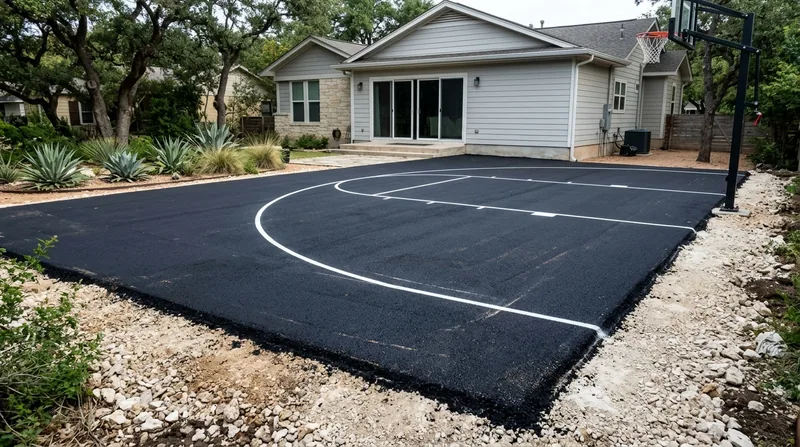




A backyard sports court and path paving project in Austin demands more than hot mix asphalt and a roller. East of I-35, Blackland Prairie clay swells under rain and cracks open in the dry weeks that follow, lifting a finished court and cracking its surface. West toward Dripping Springs and the Hill Country, thin soil over limestone means you are grading into bedrock, and the court must be built on a base stable enough to handle both the seasonal movement and the intense runoff from the region's high-intensity storms. Whether you are building a basketball court, a tennis court, or a walking path that needs to stay flat through drought and deluge, we grade and compact a stable base matched to your soil, then finish with hot mix asphalt so the court plays true. Austin Asphalt Paving has been building courts and paths across Greater Austin since 2012, and we understand the ground you are building on.
Why Sports Court and Path Paving Matters in Austin's Climate
Austin's weather and soil combine to make a properly built court foundation essential. The Blackland Prairie clay that dominates east of I-35 is expansive, meaning it swells when wet and shrinks when dry. A court built without a solid compacted base will heave and crack as the clay moves beneath it, cracking the asphalt surface and creating uneven spots that ruin play. West of I-35, the limestone and thin soils of the Hill Country bring a different challenge: rapid drainage and shallow bedrock mean the court must be graded into a stable cut, with drainage managed so runoff does not undermine the base during the heavy rains that hit the region in spring and fall.
- We excavate and grade the court bed, removing unsuitable soil and rock and building a compacted base matched to your local soil type and drainage.
- We bring in stone base or recycled asphalt millings as a stable foundation layer, proof-rolling to verify compaction before we lay asphalt.
- We finish with hot mix asphalt at the thickness required for court play, so the surface stays flat and true through seasonal soil movement.
- We slope the court for drainage and finish edges so water runs off cleanly and does not pool or undermine the base.
A court built this way will play flat and last through the clay swelling cycles and the heavy rains that dominate Austin's seasonal rhythm.
Local example: In the Hyde Park and Travis Heights neighborhoods, where pre-war homes sit on deep lots with thin soils, we have built courts on 4 to 6 inches of compacted base to handle the clay movement. In Dripping Springs and the Hill Country west of Austin, courts are graded into the rock and built with careful drainage so spring runoff does not wash out the base.
For more on how base preparation protects asphalt in Austin's soil conditions, see our page on gravel driveway installation and grading, which covers the same foundation principles.
How We Build a Sports Court or Path in Austin: Step by Step
Every court starts with the ground. We begin with a site visit to understand your soil, drainage, and the court's intended use. We then excavate the court bed to the depth required by your soil type, remove unsuitable material, and bring in stone base or recycled asphalt. We compact each layer in lifts, proof-rolling to verify density. Once the base is solid, we lay hot mix asphalt at the thickness the court demands, finishing edges and slope for drainage. The entire process takes 3 to 5 days depending on court size and weather.
- We measure the court area and mark the limits, then excavate to the depth required by soil conditions and base design.
- We remove unsuitable soil and rock, and grade the bed to the slope required for drainage.
- We bring in stone base or recycled asphalt millings in lifts, compacting each layer and proof-rolling to verify density.
- We lay hot mix asphalt at the finished thickness, typically 2 to 3 inches for a court surface.
- We finish edges, slope the court for drainage, and leave the surface ready for play.
The entire foundation and paving work is complete before you use the court, with no curing delays that would prevent play.
Real example: A residential basketball court in Round Rock required 6 inches of compacted stone base to handle the clay soils common in the post-war subdivisions north of Austin. We excavated 18 inches, removed clay, brought in stone in three compacted lifts, then finished with 2.5 inches of hot mix. The court was ready for play in four days and has remained flat through three seasons of clay movement and spring storms.
See our sports court paving in Austin (78703) page for more detail on court work in the central city neighborhoods.
Sports Court and Path Paving Methods and Materials
| Approach | Description | Best For |
|---|---|---|
| Full-depth court build | Excavate unsuitable soil, build compacted stone or recycled asphalt base, finish with hot mix asphalt at 2 to 3 inches. | New courts or courts where soil is unstable or drainage is poor. Standard for clay and thin-soil sites in Austin. |
| Overlay on existing court | Mill or grind the existing asphalt surface, repair or reinforce the base if needed, lay new hot mix asphalt. | Courts with a sound base but a cracked or worn playing surface. Faster and lower cost than full rebuild. |
| Walking or jogging path | Grade and compact a base, finish with 1.5 to 2 inches of hot mix asphalt. Narrower and less load-bearing than a court. | Residential or HOA pathways that need a durable, weather-resistant surface. Common in Zilker, Zilker Park, and Hill Country properties. |
| Recycled asphalt base with hot mix finish | Use recycled asphalt millings as the base layer, compacted in lifts, then finish with hot mix asphalt on top. | Budget-conscious projects or sites where recycled material meets engineering needs. Reduces waste and cost compared to virgin stone. |
Sports Court and Path Paving Cost in Austin: What to Expect
A residential sports court in Austin runs starting at $8,500 for a small half-court (roughly 1,000 square feet) with a standard compacted base and hot mix finish. A full court or a larger path will cost more, depending on excavation depth, base material, and site access. The biggest cost drivers are soil conditions and how much unsuitable material we need to remove. East of I-35, where clay is deep and expansive, base preparation is more involved. West toward the Hill Country, rock removal can add cost. We also factor in drainage, slope, and edge finishing. We provide a free estimate with written tonnage and thickness specs, and we recommend getting 2 to 3 estimates so you can compare base design and material choices. See our full pricing overview for ranges on court and path work.
Sports Court and Path Paving Near Me: What Austin Homeowners Should Know When Hiring
Hiring the right contractor for a court or path project means checking that they understand local soil, can explain their base design, and will give you a written estimate with tonnage and thickness. Ask any contractor how they handle clay swelling or drainage on your specific lot. Ask for references from courts or paths they have built in your neighborhood or on similar soil. If your court is in an HOA, verify architectural standards and whether an HOA approval is required before work starts. Some municipalities in Greater Austin require a permit for grading or drainage work, so ask your contractor to help you verify with your local building department. We are fully insured and have built courts across Austin, Round Rock, Cedar Park, Pflugerville, and the Hill Country since 2012. Contact us for a free estimate and we will walk you through the design and timeline.
Sports Court & Path Paving in Austin: Pricing Guide
| Service | Price | Details |
|---|---|---|
| Half-court (1,000 sq ft) with standard base | Starting at $8,500 | Compacted stone base and 2.5 inch hot mix asphalt finish, includes excavation and drainage sloping |
| Full court (2,000 to 2,500 sq ft) with standard base | Starting at $16,000 | Excavation, compacted base, 2.5 to 3 inch hot mix finish, drainage and edge work included |
| Walking or jogging path (per 100 linear feet) | Starting at $1,200 | Grading, compacted base, 1.5 to 2 inch asphalt finish, width typically 4 to 6 feet |
| Overlay on existing court surface | Starting at $4,500 | Mill existing surface, repair base if needed, lay new hot mix. Cost depends on existing condition and court size |
| Site with poor drainage or deep clay removal | On estimate | Extra excavation, base reinforcement, or drainage work requires site visit to quote accurately |
| Free estimate | No charge | Written specs with tonnage and thickness, response within 24 hours, call (737) 256-6070 anytime |
Indicative pricing, the exact cost depends on square footage, finish, and site access. Free personalized estimate within 24h at (737) 256-6070.


