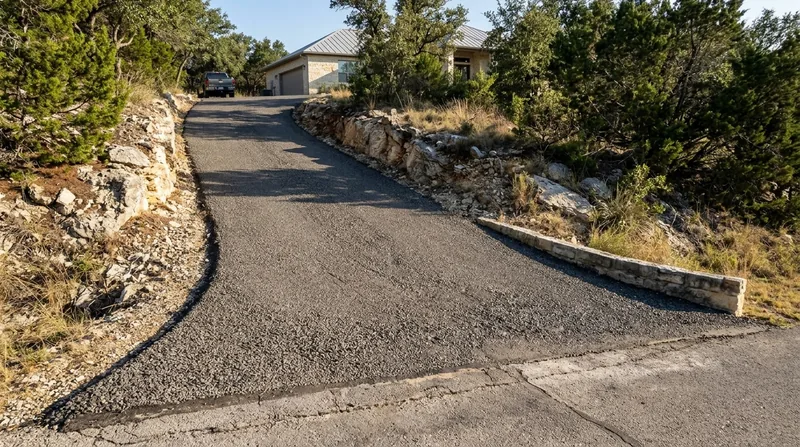




Tar and chip driveways in Austin offer Hill Country homeowners a durable, gripping surface that handles steep grades and sheds water fast, without the full cost of hot mix asphalt. Built on a compacted base sealed with hot liquid asphalt and set with stone chips, tar and chip gives you a rustic texture that grips even on the steepest climb, sheds runoff before it pools, and costs less than a full asphalt install. Whether your drive cuts into limestone west of the river, sits on Blackland Prairie clay that swells and cracks through the wet and dry cycle, or runs a long rural grade in Bastrop or Burnet County, tar and chip delivers the traction you need without the premium price. We have been building these surfaces since 2012, and we know which base prep, seal thickness, and stone size work on each terrain Austin throws at us. Call us for a free estimate, and we will walk you through whether tar and chip fits your drive or whether a different surface makes better sense for your lot and your budget.
Why Tar and Chip Matters on Austin Driveways: Traction and Drainage on Steep Terrain
Austin's Hill Country and rural edges demand surfaces that grip and drain. Tar and chip excels where asphalt alone can slip in rain or ice, and where poor drainage turns a driveway into a runoff channel. The stone chips embedded in the seal layer create mechanical grip that holds a wheel on a steep grade, and the open texture lets water percolate through instead of pooling at the apron. On the clay belts east of I-35 and north through Pflugerville and Cedar Park, where the soil swells after heavy rain and cracks in the dry weeks that follow, tar and chip flexes with the ground and resists the alligator cracking that breaks apart rigid asphalt on an unstable base. On rural county roads in Bastrop or Marble Falls, where the drive is graded into a rock cut and storm runoff cuts fast downslope, tar and chip sheds that water before it erodes the shoulder.
- We grade and compact the base to shed water and support the seal layer without settlement.
- We heat the liquid asphalt to the right temperature so it bonds the stone and cures properly without bleeding through.
- We choose stone size and chip density to match your grade and drainage needs, not a one-size-fits-all product.
- We keep the surface gripping year-round, even on ice or wet limestone, because the chips stay on top and do not polish smooth like asphalt.
On a steep driveway or a rural lane, tar and chip outperforms asphalt for grip and outperforms gravel for durability. It is the right call for many Austin properties, and we tell you straight if it is not the right call for yours.
Local example: A home in Dripping Springs with a 12-percent grade to the garage used to lose traction in rain. A tar and chip surface with 3/8-inch chips and a 1.5-inch compacted depth grips that slope even when wet, sheds the runoff that used to pool at the apron, and cost 40 percent less than a full asphalt replacement. The same surface on a flat driveway in Round Rock would be overkill, because flat driveways do not need that grip and do not benefit as much from the drainage advantage.
For more information on how different surfaces handle Austin terrain, see our page on gravel driveway installation and grading, which covers base prep that tar and chip depends on.
How We Build a Tar and Chip Driveway in Austin: Step-by-Step Process
A tar and chip driveway is not a quick patch. It is a built surface, and we do it in stages so the seal and stone bond properly and last. We start by inspecting the base for soft spots, ruts, or poor drainage, then we grade and compact the subgrade to slope away from the house and shed water. We bring in gravel base if the existing surface is too thin or unstable. Once the base is solid and properly sloped, we heat the liquid asphalt to between 300 and 350 degrees Fahrenheit, spray it onto the prepared surface in a controlled layer, and immediately spread the stone chips so they embed into the warm seal while it is still tacky. The chips lock in place as the asphalt cools, and the surface cures over the next week or two before you drive on it regularly.
- We inspect the existing surface and base to identify soft spots, poor drainage, or ruts that need repair before we seal.
- We grade the subgrade to a 2 to 4 percent slope so water runs off and does not sit under the seal.
- We add or repair the base layer with compacted gravel if the existing base is too thin or has failed.
- We heat the liquid asphalt to the correct temperature and spray it in a measured thickness so it bonds the stone without bleeding through.
- We spread the stone chips immediately, at the density your slope and traffic pattern require, so they embed fully into the hot seal.
- We let the surface cure for 7 to 14 days before you drive on it regularly, and we explain the curing timeline so you are not surprised by soft spots in the first week.
The result is a surface that grips, drains, and costs less than hot mix asphalt, but it demands a solid base and correct technique. We do both.
Real example: A rural property near Taylor had a 200-foot gravel lane that washed out every time a heavy storm hit. The grade was steep and the clay soil underneath swelled and cracked. We compacted a new base, sloped it to shed water, and laid a tar and chip surface with 1/2-inch chips at a density of 120 pounds per square yard. Three years later, the surface still grips and sheds runoff. No washout, no gravel replacement, no dust cloud when a car passes. That is what proper base prep and the right seal thickness deliver.
To learn more about base preparation and how it supports any paved surface, see our page on asphalt resurfacing and overlay, which explains the compaction and drainage principles that tar and chip relies on.
Tar and Chip Methods: Seal Thickness, Stone Size, and Density
Not all tar and chip surfaces are the same. The seal thickness, stone size, and chip density vary with the slope, traffic, and drainage needs of your driveway. A flat residential driveway in a subdivision gets a lighter seal and smaller chips. A steep rural lane gets a thicker seal and larger chips so the stone stays locked in place and grips the slope. We spec each job based on what your drive actually needs, not what we have leftover or what is cheapest to buy.
| Approach | Description | Best For |
|---|---|---|
| Light Seal, 1/4-inch Chips | 1 to 1.25 inches of compacted depth with small crushed limestone or granite chips, 80 to 100 pounds per square yard. | Flat or low-slope residential driveways in subdivisions where light traffic and good drainage are the goal. |
| Standard Seal, 3/8-inch Chips | 1.5 inches of compacted depth with medium chips, 100 to 120 pounds per square yard, the most common spec. | Moderate slopes and mixed traffic, including rural lanes and Hill Country driveways where grip and durability matter. |
| Heavy Seal, 1/2-inch Chips | 1.75 to 2 inches of compacted depth with larger chips, 120 to 150 pounds per square yard, for steep or high-traffic lanes. | Steep grades above 8 percent, rural county roads, and properties where winter traction or heavy equipment access is critical. |
| Custom Blend | Mixed chip sizes and seal thickness tailored to your specific slope, soil, and drainage pattern after we inspect the site. | Complex terrain, very steep drives, or properties where standard specs do not match the actual conditions. |
Every job gets a written estimate with the seal thickness, chip size, and tonnage per square yard spelled out. That spec is what you are paying for, and it is what we deliver. No surprises, no shortcuts.
Tar and Chip Driveways Cost in Austin: What to Expect
Tar and chip costs less than hot mix asphalt, but more than gravel, because you are getting a sealed, stable surface that lasts longer and grips better. Price depends on the seal thickness, stone size, base condition, and how much grading or repair the site needs before we lay the seal. A straightforward residential driveway on a solid base costs less than a steep rural lane that needs new base material and custom stone sizing. We provide a written estimate after we measure and inspect your drive, and we include the tonnage and depth so you know exactly what you are paying for.
- Seal thickness and stone size are the biggest cost drivers, because heavier seals and larger chips cost more per square yard.
- Base repair or replacement adds cost if the existing base is soft, poorly drained, or too thin to support the new surface.
- Slope and terrain affect labor and material cost, because steep sites and complex grading take longer and use more equipment.
- Site access and parking affect equipment placement and labor efficiency, so a narrow driveway in a tight lot costs more per square yard than an open lane.
Tar and chip starting at $5 per square foot is a realistic floor for a standard residential job with a solid base and moderate slope. Steep rural lanes, custom stone blends, or significant base repair can run higher. The best way to know your actual cost is to call us for a free estimate. We measure your drive, inspect the base, and give you a firm number with tonnage and depth included.
For a full pricing overview and to compare tar and chip to other surface options, see our pricing page.
Tar and Chip Driveways Near Me: What to Look for When Hiring a Contractor in Austin
Tar and chip is a built surface, not a material you can compare on price alone. The difference between a durable drive and one that fails in two years is in the base prep, the seal temperature, the stone size, and the compaction. When you call a contractor, ask how they prepare the base, what seal thickness and stone size they spec for your slope, and whether they give you a written estimate with tonnage and depth. Ask for references from recent jobs, especially on slopes similar to yours. If a contractor shows up with an unsolicited offer and a price that is too good to be true, or if they want a large cash deposit before they give you a written contract, call someone else. Honest contractors measure your drive, inspect the base, and give you a firm estimate in writing.
- Get a written estimate that includes the seal thickness in inches, the stone size in millimeters or inches, and the tonnage per square yard.
- Ask whether the base will be graded and compacted to slope away from your house, and whether any existing soft spots or ruts will be repaired.
- Check references from recent tar and chip jobs on slopes similar to yours, and ask those homeowners about durability and grip in wet weather.
- Verify that the contractor is fully insured, and ask for a certificate of insurance naming your address as the location of work.
- If your driveway apron or extension touches the street or right-of-way, ask the contractor whether a municipal permit is required and who will pull it. Verify with your city or village building department, because rules vary across the Austin area.
- If you are in an HOA community, check your architectural guidelines to make sure tar and chip is approved as a driveway surface, because some HOAs restrict to asphalt or concrete only.
A contractor who gives you a firm, written estimate with specs and tonnage, listens to your needs, and answers your questions about base prep and permits is the one to hire. We are that contractor, and we are here to help you navigate the local rules and the technical choices. Call us at (737) 256-6070 or request a free estimate online.
Tar & Chip Driveways in Austin: Pricing Guide
| Service | Price | Details |
|---|---|---|
| Light Residential Tar and Chip (flat or low slope) | Starting at $5/sq ft | 1 to 1.25 inches compacted depth, small chips, 80-100 lbs/sq yd, for flat driveways with good existing base |
| Standard Tar and Chip (moderate slope, residential or rural lane) | Starting at $6/sq ft | 1.5 inches compacted depth, 3/8-inch chips, 100-120 lbs/sq yd, includes base grading and drainage, most common specification |
| Heavy Duty Tar and Chip (steep grades, rural roads) | Starting at $7/sq ft | 1.75 to 2 inches compacted depth, 1/2-inch chips, 120-150 lbs/sq yd, for slopes above 8 percent or high-traffic lanes |
| Base repair or replacement (soft subgrade, poor drainage) | On estimate | Cost varies with depth of repair and material required, evaluated on-site, added to seal cost if needed |
| Travel and estimate | Free | No charge for travel within Austin and surrounding service areas, free written estimate within 24 hours of your call |
Indicative pricing, the exact cost depends on square footage, finish, and site access. Free personalized estimate within 24h at (737) 256-6070.


