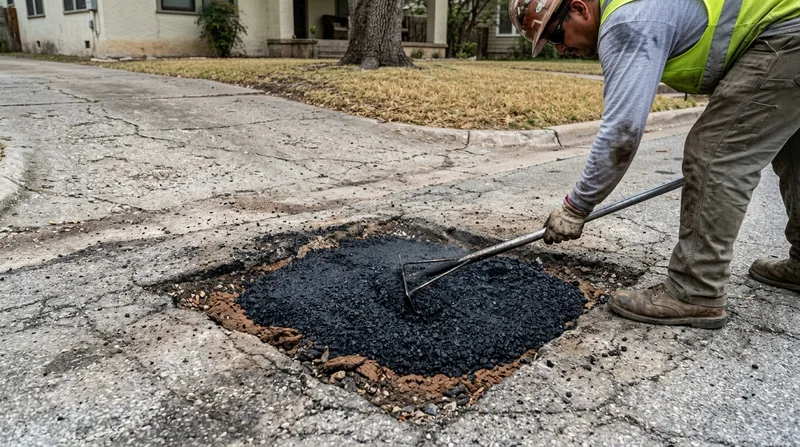




Potholes in Austin driveways almost always start the same way: heavy rain soaks the clay base under your asphalt, the clay shifts and settles as it dries, and a depression opens up. The next storm fills that pocket with water, the freeze-thaw cycle or heavy traffic breaks the edges, and what began as a soft spot becomes a crater. Pothole repair and asphalt patching in Austin stops that cycle by cutting out the failed section, rebuilding the base properly, and sealing it flush with hot mix asphalt so water cannot pool there again. This is not a cosmetic fix. A pothole that spreads can undermine the asphalt around it, force you into expensive resurfacing, or damage a vehicle. We cut it out, do it right, and move on. Our work carries a one-year workmanship warranty on every patch.
Why Pothole Repair Matters in the Austin Clay Belt
Austin's geography is the culprit here. The Blackland Prairie clay that underlies much of the city, from Pflugerville south through Buda and Kyle, swells when wet and shrinks when dry. A driveway poured without a proper compacted base sits on top of that moving ground. After a Hill Country downpour, the clay expands and pushes up; in the dry weeks that follow, it contracts and leaves a void. Traffic or the weight of a parked car then breaks through the thin asphalt skin into that empty space, and a pothole is born. The post-war ranch neighborhoods of Northwest Hills and the older subdivision belts along I-35 built their driveways on caliche or compacted fill decades ago; many have never been repaired and are now cracking and settling. Even in the Hill Country west toward Dripping Springs, where limestone bedrock sits closer to the surface, heavy runoff from high-intensity storms can scour the base and leave soft spots.
- Potholes expand quickly because water keeps working into the void under the broken asphalt.
- Patching a single pothole costs far less than resurfacing the entire driveway when caught early.
- A proper patch that includes base repair holds through the next several wet-dry cycles, not just weeks.
- Ignoring a pothole allows the failure to spread to sound asphalt around it, turning a $500 repair into a $3,000 resurface.
Catching a pothole before it grows is the single best investment in your driveway's life.
Key info: Austin's building code and the City of Austin Development Services require a right-of-way permit for any driveway work that touches the street apron or curb cut. Verify with your neighborhood or HOA before scheduling, as some master-planned communities in Northwest Hills and Cedar Park have architectural rules about driveway materials and repair methods.
How We Repair Potholes and Patch Asphalt in Austin
Every pothole patch starts with honest diagnosis. We look at how large the hole is, whether the asphalt around it is still sound or if alligator cracking means the base is failing across the whole driveway, and whether the pothole is isolated or part of a pattern. If it is just one or two potholes on an otherwise solid drive, we patch them. If the driveway is crazing and cracking in multiple places, we talk about resurfacing or overlay because patching money thrown at a failing base is wasted. When patching is the right call, we cut the pothole out with clean vertical walls so the patch has something to grip, excavate down to solid base or bedrock, rebuild the base with compacted stone and asphalt millings if needed, and then set the hot mix patch flush with the surrounding surface so water runs off and does not pond.
- We cut out the pothole with clean edges so the patch bonds to sound asphalt and does not separate at the perimeter.
- We inspect and repair or replace the base layer so the patch does not reopen after the next heavy rain.
- We compact the base in lifts using a vibratory compactor so it will not settle and leave a depression.
- We fill with hot mix asphalt at the proper temperature and tamp it flush with the surrounding surface.
- We allow the patch to cool and cure before the driveway is back in service, typically same-day for light use.
The difference between a patch that lasts and one that fails is base repair and proper compaction. We do not skip either.
Example: A homeowner in Travis Heights had two potholes open up after the spring rains, one near the garage and one near the street. The asphalt around them was still sound with no crazing. We patched both, rebuilt the clay base under each one, and sealed them flush. Two years later, no regrowth. Total cost was $680, versus $4,200 to resurface the whole 400-square-foot drive.
Pothole Repair Methods: Cold Patch vs. Hot Mix Patch
| Approach | Description | Best For |
|---|---|---|
| Hot Mix Patch (Thermal) | We heat and mix fresh asphalt, compact it into the cleaned pothole, and tamp it level with the surface while hot. It bonds tightly to the surrounding asphalt as it cools. | All permanent repairs. This is what we use because it holds. |
| Cold Patch (Temporary) | Pre-mixed cold asphalt comes in bags and does not require heating. It can be applied in winter or when we cannot heat on-site. It bonds weakly and breaks apart under traffic within months. | Emergency temporary fill only, never our first choice for a lasting fix. |
| Full-Depth Patch with Base Rebuild | We cut out the pothole down to subgrade, replace the base with compacted stone and millings, and set a hot mix patch on top. This is the only method that addresses the root cause: a failed or missing base. | Potholes where the base has shifted or washed out, or where the hole is larger than 12 inches across. |
| Spray Injection (Edge Seal) | We cut and clean the pothole, inject a liquid binder around the perimeter to prevent water infiltration, and top with hot mix. This protects the bond between the patch and surrounding asphalt. | Patches on older or weathered asphalt where edge separation is a risk. |
Pothole Repair and Asphalt Patching Cost in Austin: What to Expect
A single pothole patch in Austin typically starts at $450 and can run to $800 or more, depending on how deep the hole is, whether the base needs replacement, and how large the repair area becomes once we cut it out cleanly. A pothole that looks 6 inches across on the surface might be 12 inches across once we remove the broken asphalt, which means more base work and more hot mix. If you have two or three potholes on the same driveway, we can patch them in one visit and give you a combined price. A driveway with six or more potholes or extensive alligator cracking is usually a candidate for resurfacing rather than patching, because the base is likely failing across the whole surface and patching will not stop the cracking.
Factors that move the price up include the depth of the pothole (deeper holes need more base material and compaction), whether we need to haul away failed asphalt and soil, access and parking (a driveway in a tight lot in Hyde Park takes longer than one in a suburban cul-de-sac), and proximity to the street (apron work that requires a city permit adds time). We measure on-site and give you a written estimate with tonnage and thickness specs so you know exactly what you are paying for. Get estimates from at least two contractors so you can compare. The cheapest price is often the fastest failure; the contractor who spends time on base repair and gives you specs on paper is the one to hire.
For a detailed breakdown of pricing across all our services, see our full pricing page.
Pothole Repair and Asphalt Patching Near Me: What Austin Homeowners Should Know Before Hiring
Paving is not a licensed trade in Texas at the state level, but the City of Austin and other municipalities in the area do require permits and contractor registration for driveway work that touches the right-of-way. Before you hire anyone, verify that they are fully insured and willing to help you navigate local permitting. Ask for references from recent jobs in your neighborhood, and call two or three of them. A contractor who has been in your area for years and knows the local soil and climate is worth more than an out-of-state crew quoting over the phone. Avoid anyone who shows up at your door unsolicited, quotes a price without measuring, demands a large cash deposit before starting, or promises work that sounds too cheap. Those are the classic red flags of a paving scam.
- Verify that any contractor you hire carries general liability insurance and can provide a certificate on request.
- Check whether your city or HOA requires a permit for driveway patching or apron work, and confirm the contractor will help you get it.
- Ask for a written estimate that includes the size of the repair, the depth and tonnage of asphalt or base material, and a start and end date.
- Get at least two estimates so you can compare method and price across contractors.
- Call references from recent pothole or patch jobs, not just any driveway work, because patching requires different expertise than new installation.
- Confirm the warranty period in writing, typically one year on workmanship for patching.
We are local, have been in business since 2012, and we are happy to answer questions about your driveway before you decide to hire us. Call us for a free estimate at (737) 256-6070. We respond within 24 hours and will walk you through the repair process and any permits your city requires.
Pothole Repair & Asphalt Patching in Austin: Pricing Guide
| Service | Price | Details |
|---|---|---|
| Single pothole patch | Starting at $450 | Includes cutting, base inspection, compaction, and hot mix fill flush with surface, typical pothole 8 to 12 inches |
| Multiple potholes (2 to 3) | Starting at $650 | Same-visit repair of two or three potholes on the same driveway, combined pricing reflects efficiency and shared mobilization |
| Deep or large pothole with base replacement | Starting at $750 | Pothole larger than 12 inches or requiring subgrade excavation and compacted stone base rebuild before patching |
| Extensive potholes or alligator cracking | On estimate | Six or more potholes or widespread crazing usually indicates full base failure, resurfacing is more cost-effective than patching |
| Travel | Included | No separate fee for Austin and surrounding service areas, mileage is built into the estimate |
| Free estimate | Free | On-site measurement and written quote with tonnage specs, response within 24 hours at (737) 256-6070 |
Indicative pricing, the exact cost depends on square footage, finish, and site access. Free personalized estimate within 24h at (737) 256-6070.


