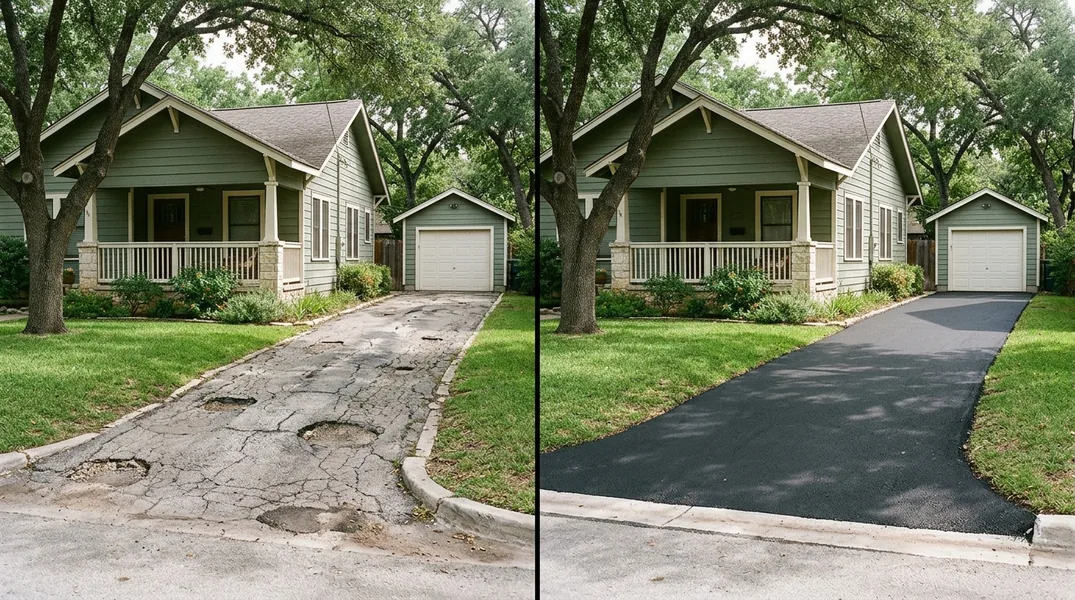
The Drainage Challenge of Allandale and Northwest Hills Driveways
The charming post-war ranch neighborhoods of Allandale and Northwest Hills represent some of Austin's most desirable residential areas. Built primarily between the 1950s and 1970s, these communities feature classic single-story homes with character and established tree canopies that many newer developments simply cannot replicate. However, the driveways that serve these homes were designed and constructed decades ago, often without the sophisticated drainage considerations that modern asphalt installation demands.
One of the most persistent problems affecting these vintage driveways is improper water drainage. Many original driveways in these neighborhoods were poured with minimal slope or without any subsurface drainage infrastructure. Over the past 50 years, soil settling, tree root growth, and the natural expansion and contraction of asphalt have created low spots where water pools after rain. In Austin's subtropical climate, where heavy downpours are common during spring and fall, water pooling on driveways isn't just a cosmetic issue. Standing water accelerates asphalt deterioration, penetrates cracks, and can cause foundation problems if it's directed toward your home. Understanding these drainage challenges is the first step toward protecting your property investment.
Why Water Pooling on Driveway Becomes a Costly Problem
Water pooling on driveway surfaces might seem like a minor inconvenience, but it's actually a warning sign of serious structural problems developing beneath the surface. When water sits on asphalt instead of flowing away, it seeps through micro-cracks and into the base layers below. The asphalt base typically consists of gravel or recycled asphalt, materials that erode when constantly saturated. As the base deteriorates, the top layer of asphalt loses support and begins to crack, buckle, and develop potholes. This cycle accelerates dramatically in climates like Austin's, where freeze-thaw cycles (though mild compared to northern regions) still occur during winter months.
Beyond the driveway itself, pooling water creates additional problems. If your driveway slopes toward your home's foundation, water can accumulate near your foundation walls, leading to moisture intrusion, mold growth, and structural settling. Conversely, if water pools in low spots along the property line, it can damage neighboring properties and create liability concerns. The cost of addressing water damage to a home's foundation far exceeds the investment in proper Asphalt Resurfacing & Overlay with integrated drainage solutions. Homeowners who wait until their driveways are severely damaged often face bills two to three times higher than they would have paid for preventative resurfacing with proper drainage design.
Modern Driveway Drainage Solutions: French Drains and Trench Systems
Contemporary asphalt paving contractors now have several proven methods to solve drainage problems that plagued older driveways. A driveway french drain is one of the most effective solutions, particularly for properties where water naturally pools in specific low spots. A french drain system consists of a perforated pipe buried beneath or alongside the driveway, surrounded by gravel that allows water to filter through. The pipe directs water away from problem areas toward a designated drainage point, such as a storm drain, dry well, or landscaped swale. This solution works exceptionally well for the sloped terrain of many Northwest Hills properties, where gravity can help move water naturally downhill.
Another increasingly popular option is a trench drain driveway system, which uses a linear drain channel installed across the width of the driveway surface. These channels are typically placed at the base of slopes or at property lines where water would naturally accumulate. The trench drain captures water before it can pool and directs it through underground piping to appropriate drainage infrastructure. For homeowners in Allandale and Northwest Hills who want a seamless aesthetic, modern trench drains can be installed flush with the driveway surface and are barely noticeable once the asphalt is poured. The combination of proper grading, french drains, and trench drain systems creates a comprehensive driveway drainage solutions approach that addresses both surface and subsurface water management.
The Resurfacing Process: Combining Drainage with Asphalt Overlay
When Austin Asphalt Paving assesses a driveway for Asphalt Resurfacing & Overlay, we don't simply apply new asphalt over old pavement. A comprehensive resurfacing project begins with site evaluation to identify drainage problems, existing damage, and structural concerns. If your driveway shows signs of water pooling, we'll recommend incorporating drainage improvements into the resurfacing plan. This might involve removing sections of the existing asphalt to install subsurface drainage infrastructure, then re-paving with a properly engineered slope that directs water away from problem areas.
The actual resurfacing process typically involves milling the top layer of existing asphalt, which removes the worn surface while preserving the base layers if they're still sound. This step also allows us to create proper grading during the paving process. Once the surface is prepared, new asphalt is applied in layers, with each layer properly compacted to ensure durability. For driveways in older neighborhoods like Allandale, where trees can shift soil and create uneven settling, we often recommend thicker overlay applications and the installation of driveway drainage solutions that account for potential future settling. The entire process typically takes one to three days, depending on the driveway size and complexity of drainage improvements needed.
Asphalt Driveway Paving & Installation Near Me: When to Call Austin Asphalt Paving
If your driveway in Allandale, Northwest Hills, or anywhere in Austin shows any signs of water pooling, significant cracking, or surface deterioration, it's time to call a professional. Austin Asphalt Paving has been serving the Austin area for years, helping homeowners protect their properties with expert Asphalt Driveway Paving & Installation and resurfacing services. We understand the specific challenges that post-war ranch driveways face in this region, and we design solutions that address both immediate drainage problems and long-term durability.
The best time to address driveway drainage issues is before they become major problems. If you've noticed water sitting on your driveway after rain, or if your driveway has developed cracks and potholes, don't wait. Contact Austin Asphalt Paving today at (737) 256-6070 to schedule your free estimate. We'll inspect your driveway, identify drainage concerns, and provide you with a detailed plan for resurfacing that will protect your home and restore your driveway's functionality and appearance for years to come.
Planning Your Driveway Resurfacing Project: Timeline and Next Steps
Once you've decided to move forward with driveway resurfacing, understanding the timeline helps you plan accordingly. Most residential driveway projects in Austin can be completed within one to three business days, though complex drainage installations might require additional time. Weather plays a role in scheduling as well. Austin's hot summers make asphalt paving easier in many respects, but extreme heat can affect cure times. Spring and fall typically offer ideal conditions for paving work. When you contact Austin Asphalt Paving for your free estimate, we'll discuss the best timing for your project and answer any questions about how drainage improvements will be incorporated.
The investment in proper driveway resurfacing with integrated drainage solutions is an investment in your home's longevity and value. A well-maintained driveway with proper drainage can last 15 to 20 years or more, while a driveway with unresolved water pooling problems might need major repairs within five to seven years. By addressing drainage issues during resurfacing, you're preventing future costly damage and ensuring that your driveway remains functional and attractive for decades. Call Austin Asphalt Paving at (737) 256-6070 to learn more about how we can help your Allandale or Northwest Hills home.
Looking for a professional asphalt paving contractor in Austin? Austin Asphalt Paving responds fast for all your asphalt paving needs.
Get a Free Quote